Dear reader,
Transport yourself to 100 years ago in Italy. Go ahead, pack a bag, but don’t bother packing any black or brown shirts. Your welcoming committee is Benito Mussolini himself. His Roman Empire? The Roman Empire. His aspirations? To resurrect an Italian Empire amidst global economic and political instability by any means necessary.
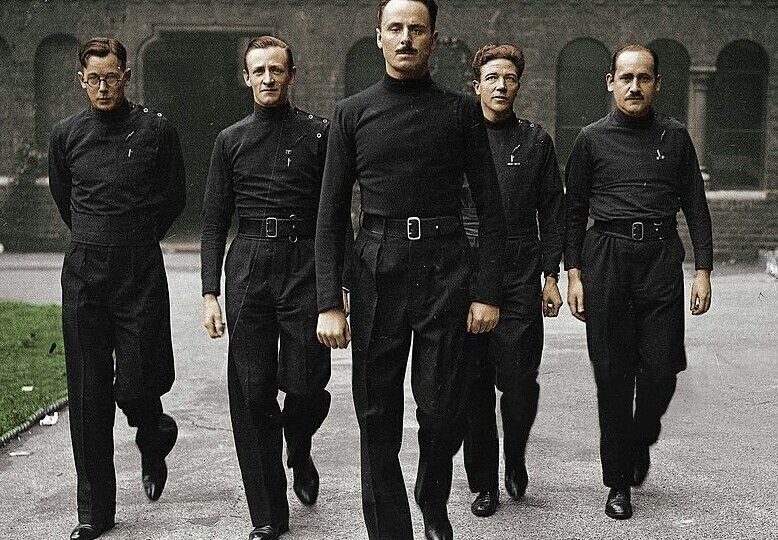
In 1922, Italy was left weak and jaded by the “mutilated victory” established by the Treaty of Versailles, which ended World War 1. Benito Mussolini put forth a means of reclaiming Italy’s glory by forging a culture of Italian machismo — asserting physical strength through violence and totalitarian government. His followers donned black, militant attire, earning their name the “Blackshirts.” They took shape as terrorist squads, attacking Mussolini’s personal enemies and enforcing the growing influence of fascism.
For Authoritarian rule to prevail in Italy, Mussolini invoked the authority and aesthetics of the Roman Empire. He was deeply invested in the legacy of Julius Caesar and Augustus; both inspired fierce nationalism through their leadership, seemingly establishing stability and strength.
Mussolini admired Caesar for his necessitated use of the rule of law and repressive “freedoms.” The fasces icon, a bundle of rods bound by an axe, symbolizes the penal power and social stratification in Ancient Rome. Mussolini engraved these fasces around the city of Rome to emphasize totalitarian unity.
The totalitarian dictator was obsessed with the aesthetic of the ancient empire, and did very little to conceal it. He was convinced a new era of imperial domination and restricted freedoms would strengthen Italy to enact revenge on its enemies within western Europe. Citizen cooperation was necessary to Mussolini’s crusade, and many were entranced by the nostalgic glory of Roman symbolism.
The Italian people were fooled by Mussolini’s cult of personality and his vision to revive the Italian republic. When in power, Il Duce choked public opposition, employed police state rule, and perpetuated poverty and inequality. For Mussolini, his weaponization of fear, enwrapped in a desire for a lost past, was essential to completing his fascist mission.
Mussolini is not the first of his kind, and surely he is not the last. Mussolini tactfully folded his authoritarian ambitions into the aesthetics of imperial glory, stability, and strength — patterns that we are seeing emulated today.
Since 2016, the United States has arguably struggled with the definition of who an American citizen is. This means that even though the Declaration of Independence, written in 1776, holds that “all men are created equal”, there is still a debate about when or how equality is manufactured.
For example, America’s liberal condition has been blemished by the disenfranchisement of enslaved and indigenous people. Their narratives have been fractured, erased, and censored throughout history, and their efforts to situate and uplift themselves to fit the American aesthetic are perpetual.
This is by no mistake; the meritocracy that exists in America does not wish to shed light on the system that demands access, skill, ability and whiteness to achieve the American dream. However, in systems where power is centralized based on ability or race, mobility is often fixed. The construct of Americanness is unachievable.
Presidents have weaponized this construct through radical maneuvers that are not merely political; they are fascist cosplay cloaked to conjure a mythological image of the ideal American. Americanness is not defined by civic participation or shared values, but by visual conformity, a racialized and classed ideal.
Mussolini used the Roman Empire to drive authoritarian goals; today, we see people invoke the luxuries of Americana. The first month in office, the press found it unavoidable to mention how President Trump’s new cabinet was filled to the brim with political castaways who had either never held an office or had never tried because of how scandalous their life has been. As some may recall, the new administration created the Department of Government Efficiency (DOGE) to cut costs in government spending.
When many Americans were struggling with economic insecurity in 2024, we ironically gave our wallets to populist billionaires to preserve economic inequality and the crisis of polarization. This mode of government, where appointed experts make value judgments at the cost of tens of thousands of Americans, is called a technocracy. While funding for government benefits to food assistance and social security, has been cut, a makeup studio has been installed in the Department of Defense for media appearances. The technocracy of the United States demonstrates that the aesthetics of America are prioritized before safety and protection.
—
According to a McKinsey State of Beauty Report, e-commerce could account for one-third of sales by 2030, doubling the force from 2019. This could be attributed to the rise of social media and influencer culture, which is reminiscent of our technocracy: brands pay prominent and wealthy people with a platform to govern consumer choices. Recent trends to look better than your neighbor, make money faster, and be smarter than robots have been accompanied by the promotion of GLP-1’s, the normalization of gambling, and artificial intelligence agents into almost every aspect of our lives.
At Super Bowl LX, Kendall Jenner made an appearance amongst a gaggle of dystopian ads to announce that she makes her fortune betting on her boyfriends. A mouthpiece for Fanatics, the Kardashian legacy tells her audience “Bet with me, or against me”, surmising that if you want to have it all like her, you have to indulge in this risky lifestyle she takes part in.
Influencers are complicit in the unraveling of democratic principles that safeguard against inequality and uncertainty. While these private citizens by no means have an obligation to be active in civic society, their promotion of products that cause harm to others further distances them from being seen as oppressors; a reminder of our administration.
However, fitting the American aesthetic of babies, botox, and blood diamonds has purposely seeped into For You pages and advertisements as a way to make sure you, yes you, assimilate to the American idealism and further propagate the image of our country on a global stage. The obsession with image—who looks the part, who fits the mold of American success—has extended beyond the body politic into governance.
Perhaps the most prominent example is “Mar-a-Lago Face”, named after the president’s Palm Beach inner circle, “rewriting the rules of aging”, says Dr. Shervin Naderi. Mostly known by lifted brows, sculpted cheekbones, tucked eyelids, tight jawlines, or beestung lips, Naderi says the face announces “excess”, “affluence”, and “control”.
Think Kristi Noem, Matt Gaetz, Pete Hegseth, or even The Real Housewives. Above all, Dr. Naderi engages with the look not being inherited, but engineered. At her practice, the initial cost of the procedures is $250,000-$300,000, signaling your individual control, affluence, and personal excess; a type of cultural currency.
Many medical spas and plastic surgery clinics report facelifts were one of the most requested procedures by clients in 2025, possibly reflecting the rise of GLP-1s, interest by mid-lifers in looking younger, or possibly something more eerie.
While minimally invasive cosmetic procedures like Botox, fillers, and lip augmentation are more popular than surgical procedures, the American Society of Plastic Surgeons reported that more Gen-Z are getting facial and breast procedures to reduce texture, minimize fine lines and sagging. My question is, who told 22-year-olds their faces are sagging?
In a recent meta-analysis of the relationship between social media and body image dissatisfaction, researchers found that algorithms on Instagram and Snapchat promote idealized images, significantly influencing about 70% of young adult women and 60% of young adult men to consider cosmetic surgery.
By preying on your worst insecurities, like our appearance, social media has found a way to market reinvention. If cosmetic surgery can rewrite the rules of aging, can it also rewrite your aesthetic?
Given the clashes of what it means to be an American on social media, or ICE infiltrating communities, murdering citizens in plain sight, the spectacle of social media has also given plenty of ways to cope with the overwhelming brutality of the past few years.
The US government has transcended social media as a sphere where they can monitor and deny entry to tourists or immigrants for content on their social media. This shift to responsible digital citizenship as a requirement to walk our sought-after streets is something that should concern all Americans, as the government is now stratifying entry into our country based on their online persona, or their digital aesthetic. I ask aspiring influencers, what if you are not American enough to enter the country one day?
Above all, the emergence of the gaudy gargoyles governing our country is a sign that wealth may no longer whisper. Wealth announces itself as a sign of merit, credibility, and most of all citizenship. To shield yourself from threats of deportation, buy yourself the president’s Gold Card for a million dollars.
A man in fascist Italy once said, “At least the trains ran on time”. While Mussolini continued his terror campaign against the Italian people, he also made innovations in transportation infrastructure. In voting for “safety” and cheaper gas, voters of the new administration can ask whose communities are safer and whose lives are more affordable?
The new administration has engineered gold gaudy ballrooms, corporate complicity, and the corrupt erosion of democratic norms in full frontal as economic crisis and growing wealth inequality happen in the background. Oxfam, an NGO fighting global poverty and inequality projects, in 2027 alone, the highest-earning 0.1% in the U.S. will receive $60.3 billion in tax breaks, while simultaneously increasing taxes on families in poverty.
In a technocracy, aesthetics are everything, where experts thrive on their own superstitions, while magnifying this reality to others near and far. So if a person leads a diatribe against people who aren’t white, rich, and aren’t born here, and claims they, the expert, the CEO, and now as the president, that these groups are less American, and less deserving of the privileges of the American experience, what are these groups supposed to do?
There is nothing natural about being American. We are led to believe that if born in the U.S., the road to the top is an easy street. However, the emergence of the surveillance state, along with ineffective leadership, social media, and rising inequality, has made this privilege that was long sought after, more and more unachievable. Citizenship is no longer defined by birth, green card, a naturalization process, or other forms of permanent residency, but by your income and generational wealth.
Warrantless authoritarianism doesn’t always wear a black military uniform; it hides in gold gaudy ballrooms, in corporate complicity, and in the quiet erosion of democratic norms.
- Aesthetics and Authoritarianism - May 7, 2026
- The Quiet Places Between - September 2, 2025