When I was younger and perpetually looking for ways to escape boredom, I filled my time with in-house scavenger hunts. One day, in my basement, I stumbled across a very distinct lightweight checkered bag with a plaid-like pattern and nylon texture.
A part of my pre-adolescent mind knew these bags were older than history itself. They were dusty, stashed in the corner of the room and filled with old items, traditional attire and aging photo albums.
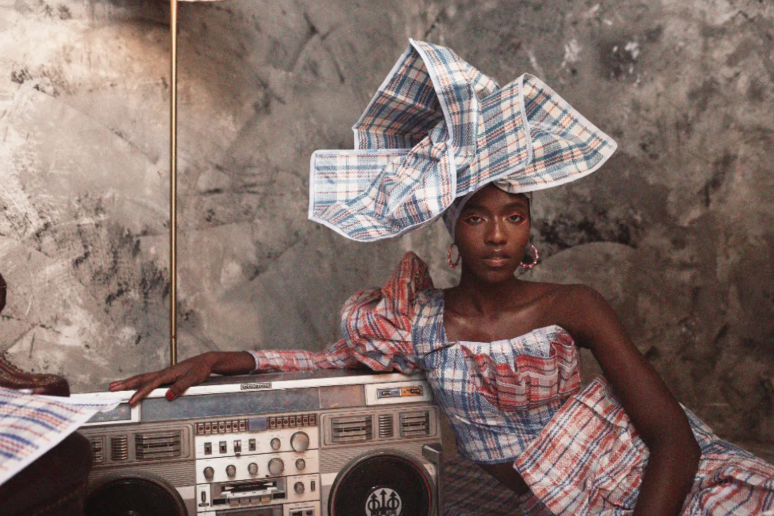
Recently, I came across a photoshoot spread titled “Anyi N’Aga,” which is Igbo for “We Are Going.” In it are various snippets of a woman wearing the same nylon fabric in red, blue and white hues I once saw in my parents’ basement. I discovered that it was curated by Obinna Obioma, a Nigerian visual artist and fashion photographer.
The fabric was similarly reconstructed on the woman to resemble the attire worn by women in Nigeria, with one piece wrapped around the model’s head like a gele, and other pieces like her pencil skirts, earrings and slim-fit dresses.
Obioma worked with designer Chioma Obiegbu and fashion stylist Wuraola Oladapo to create the pieces. From head to toe, the model’s outfits stand out as fashion statements designed to explore heritage and migration in the folds of globalization.
“[A migrant] takes something new and leaves something behind,” Obioma told The BBC.
The bag itself is a commonplace carryall that Lee Wah, a Hong Kong-based tailor in the 1960s, created. It then migrated to African cultures in the 1970s. Almost all African immigrant parents have owned one, which led me to wonder what this nylon accessory is actually called.
In fact, there isn’t one single name for it — each culture has come to refer to it differently. In Germany, it is called the Tuekenkoffer, Namibians call it the Mairandopi bag and Ghanaians name it “Efiewura Suame (Help me carry my bag).” But in Nigeria, it’s called the “Ghana Must Go” bag.
This pseudonym seems offensive at first glance, but I did not think it meant anything more than the typical tension between Nigerians and Ghanaians. I even sent my parents a picture of the bag to confirm the name, and it rings true. Beyond the bag, the name carries the weight of an unfortunate event in Nigeria.
From the 1960s to the 1970s, Ghanaians immigrated to Nigeria to escape economic issues in their home country. Most moved primarily for job opportunities generated by Nigeria’s growing oil industry.
However, by 1982, oil prices began falling, causing major issues for Nigeria’s economy. Instead of prioritizing finding a solution to the growing disparity, the Nigerian government and then-President Shehu Shagari scapegoated undocumented Ghanaian workers as the reason for the plummeting economy.
On Jan. 17, 1983, the Nigerian government ordered a mass expulsion of Ghanaian residents, demanding that all illegal immigrants leave within two weeks. Mass panic ensued, and Ghanaians resorted to packing whatever they could into the carryalls. The slogan for the order was “Ghana must go.”
The mass deportation is understandably a painful memory for those who fled such xenophobia. Over time, Nigerians began associating the slogan with the bag itself, putting it to use when bartering at local markets. But many don’t like to use the accessory, associating it with struggle and despair.
What shocked Africans in the 2010s, however, was witnessing the checkered bag trickle into high fashion.
Louis Vuitton released what they called the “Limited Edition Plaid Laundry Bag” as part of its Season 7 collection. It’s designed with the same red, blue and white plaid pattern, but with woven leather, priced at $595 — a stark contrast to the original inexpensive design.
Balenciaga also released a similar concept with the dark blue “Barbes Large East-West Shopper Bag.” The calfskin tote was priced between $2,000 and $3,000.
These brands were criticized for lacking originality by blogs and online users.
Vuyile Madwantsi, a writer for Independent Online, notably said, “Global brands want the appeal of African style, but they rarely give credit or payment to the communities behind these designs.”
Although the recognizable pattern was not born in Africa, it was undoubtedly given a life of its own through its practicality and social significance on the continent. It is safe to say that the carryall bag is a cultural signifier for the trials and tribulations different groups faced in migration.
Now, African artists like Obioma are reclaiming the fabric for their own work, taking a remnant of history and interweaving it into the many fabrics of African heritage.
It is only right that the fashion houses that took the iconic plaid pattern as their own not only give proper credit for their inspiration, but also acknowledge the painful stories associated with its Nigerian moniker.
- The Duality and Monikers of the Plaid Woven Bag “Ghana Must Go” - March 24, 2026