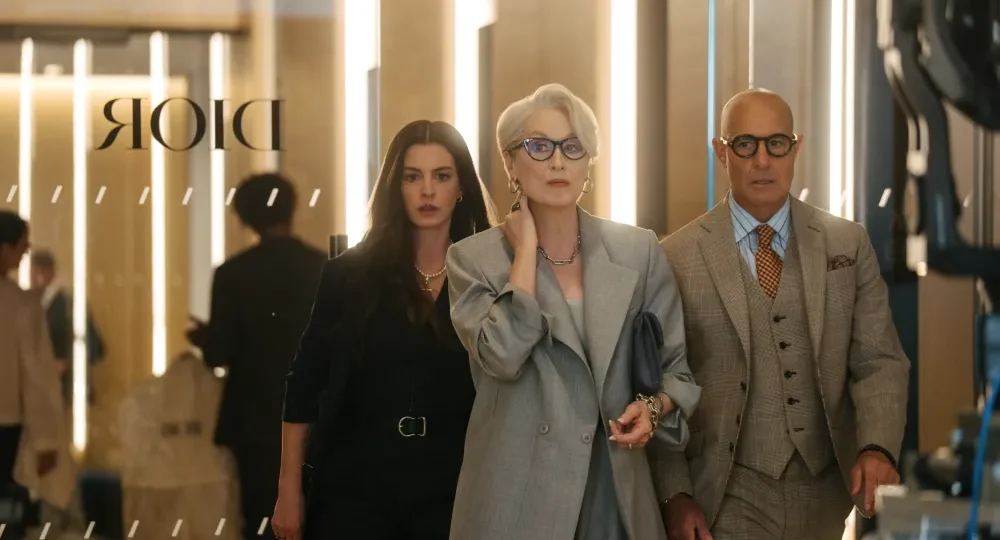
When “The Devil Wears Prada 2” arrives in May, it won’t just be another sequel — it will be a litmus test. Not for nostalgia (that’s guaranteed), but for relevance.
When “The Devil Wears Prada” first defined the intersection of fashion, power and aspiration, it did so with surgical precision. Meryl Streep’s cerulean monologue alone reframed how audiences understood trends — not as spontaneous expressions of taste, but as engineered signals flowing down from the highest echelons of the industry.
Back then, Miranda Priestly represented untouchable authority. Fashion was a fortress, and she held the keys. In 2026, however, the gates have long been flung open — or at least, they appear to be. Those in the front row now represent digital influence as much as couture, and trends are born on TikTok as often as in ateliers. Perhaps most tellingly, when Anna Wintour herself stepped out in cerulean this January, the moment felt less like irony and more like collapse: the system referencing itself in real time.
So where does that leave the sequel? The original film thrived on exclusivity, on the idea that fashion’s inner workings were mysterious and intimidating. Today, beauty and style are performative, participatory and endlessly self-aware. The aspirational sheen still exists, but it is filtered through GRWMs, affiliate links and algorithmic virality. The question is not whether Priestly still intimidates — it is whether intimidation even functions the same way in an industry built on relatability.
This tension is already visible in the sequel, which leans heavily into visual spectacle while softening the original’s critique. The clothes are now present — Streep famously said that, in the first film, people were too scared to loan their designs — and the glamour remains intact. But the bite is less pronounced. In translating fashion’s sharpest satire into something more broadly palatable, this film reveals a risk: Remove the sting, and you risk endorsing the very system you once dissected. Without tension, fashion storytelling becomes aesthetic rather than analytical.
Still, there is a blueprint for getting it right. Look no further than the musical “Death Becomes Her,” where excess is the point — and the power. With costumes by Oscar-winning Paul Tazewell, known for his work on “Wicked,” the show embraces unapologetic sparkle and high-drama silhouettes. It understands something crucial: Fashion can be both spectacle and statement. It does not shy away from camp; it weaponizes it. The result is a world that feels heightened yet incisive, indulgent yet intentional. It is fashion as fantasy, yes — but also fashion as commentary. And if audience feedback is anything to go by, it is simply sensational.
That is the balance “The Devil Wears Prada 2” must strike. Today’s fashion audience is fluent. It understands the mechanics of trend cycles, the economics of influence and the politics of visibility. A sequel that simply rehashes Priestley’s icy authority risks feeling like a museum piece — beautiful and iconic, but static. What is needed instead is evolution: a Priestly who grapples with relevance in an age where power is dispersed, taste is crowdsourced and even the most elite voices must contend with constant noise.
Whether “The Devil Wears Prada 2” matters will depend on one thing: Can it still reveal something audiences do not already know? Or has fashion, in all its self-awareness, finally outpaced its own satire?
- The Devil Wears Prada 2 - May 9, 2026