This past summer, I spent six weeks independently researching Victorian mourning jewelry throughout the United Kingdom. I was selected for the Robinson Honors Fellowship at UNC-Chapel Hill, a program that funds students interested in history and culture in the Mediterranean region. My project centered around Victorian mourning jewelry made from human hair and jet, a lightweight, organic black gemstone, to memorialize loved ones. I was based in London, but I also traveled to Oxford, Southampton, the Isle of Wight, Whitby, Haworth and York. My project expanded far beyond the physical study of jewelry. I explored how mourning jewelry preserves memory, culture and history, and how it is steadily undergoing a modern fashion revival.
My interest in mourning jewelry began when I purchased a blue locket from Portobello Road Market in London. I bought the locket for its beauty, but inside it, I found a lock of brown hair. I became fascinated by Victorian pieces and found myself wondering: How does mourning jewelry carry meaning, and how does the evolution of hairwork jewelry reflect the cultural values of the time?
My research began in London, where I met with museum curator Dr. Ruth Hibbard at the Victoria and Albert Museum. Hibbard brought out a case of mourning jewelry that was not on public display, and I had the opportunity to explore these treasures with her.
While in London, I visited an antique store called Piccadilly Vaults. I learned that legendary British fashion designer Vivienne Westwood had commissioned the store to create a custom piece made of her pubic hair. But what I found most compelling is that the hair artist currently working on this project is struggling because there might not be enough product. This is a challenge many jewelers faced during the Victorian period, because these intricate designs require a lot of hair.
On the way to Whitby, I stopped by York to visit the Brontë Parsonage Museum. I saw pieces of hair jewelry associated with Charlotte Brontë, including the bracelet that inspired Margot Robbie’s dress for the UK premiere of “Wuthering Heights.” As museum curator Dr. Murray Tremellen noted, “[The dress] got the whole world talking about Victorian mourning jewelry—something that would have been considered a niche interest only a few months ago.”
While in Whitby, I met with one of the Whitby Museum curators, Dr. Sarah Steele, and got the chance to view her personal collection of jet jewelry. Jet is a black prehistoric gemstone that washes up on Whitby’s coast and was popularized in the mid-19th century when Queen Victoria began wearing it after her husband Prince Albert’s death. It is often used to make beautiful, gothic mourning jewelry.
Steele has one of the world’s largest collections of Whitby jet. Yet the most incredible aspect of her collection is that, in addition to jewelry, Steele has photographs, magazines and the backstories of almost every piece she owns. Steele also showed me a pair of jet earrings she won at auction, which Kate Moss wore in a Spring/Summer 2016 shoot for AnOther Magazine.
I imagined that Victorian women wore these necklaces the same way we do today, but they did not. Even in Victorian times, women were fashion-forward and challenged the traditional ways of wearing jewelry. For example, they would hook the necklace strands together with a brooch for a cinched effect around the neck.
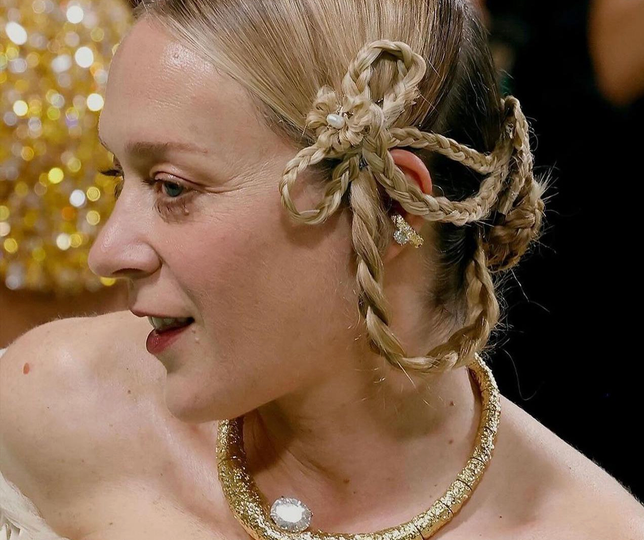
Victorian mourning jewelry and fashion have continued to share a symbiotic relationship. Iconic fashionistas continue to resurrect hair in fashion, including Chloë Sevigny at the 2024 Met Gala. Sevigny wore a custom Dilara Findikoglu piece — the same name behind Margot Robbie’s UK premiere dress — constructed from Victorian-era silk and embroidered with hair flowers reminiscent of the ornate hair designs in Victorian mourning jewelry. Hair jewelry has also been seen on the runway. Schiaparelli’s Fall/Winter 2024 show incorporated braided hair ties on the runway, bringing the surreal intimacy of hair work into high fashion.
Hair has held meaning throughout history, and it has for as long as humans have existed. It naturally finds its way into fashion shows and the minds of top celebrity stylists because hair remains innately intertwined with us.
- Bringing Back Victorian Mourning Jewelry - November 6, 2026
- Arthur Elgort: The King of Fashion’s ‘Candid Photo’ - May 8, 2026